
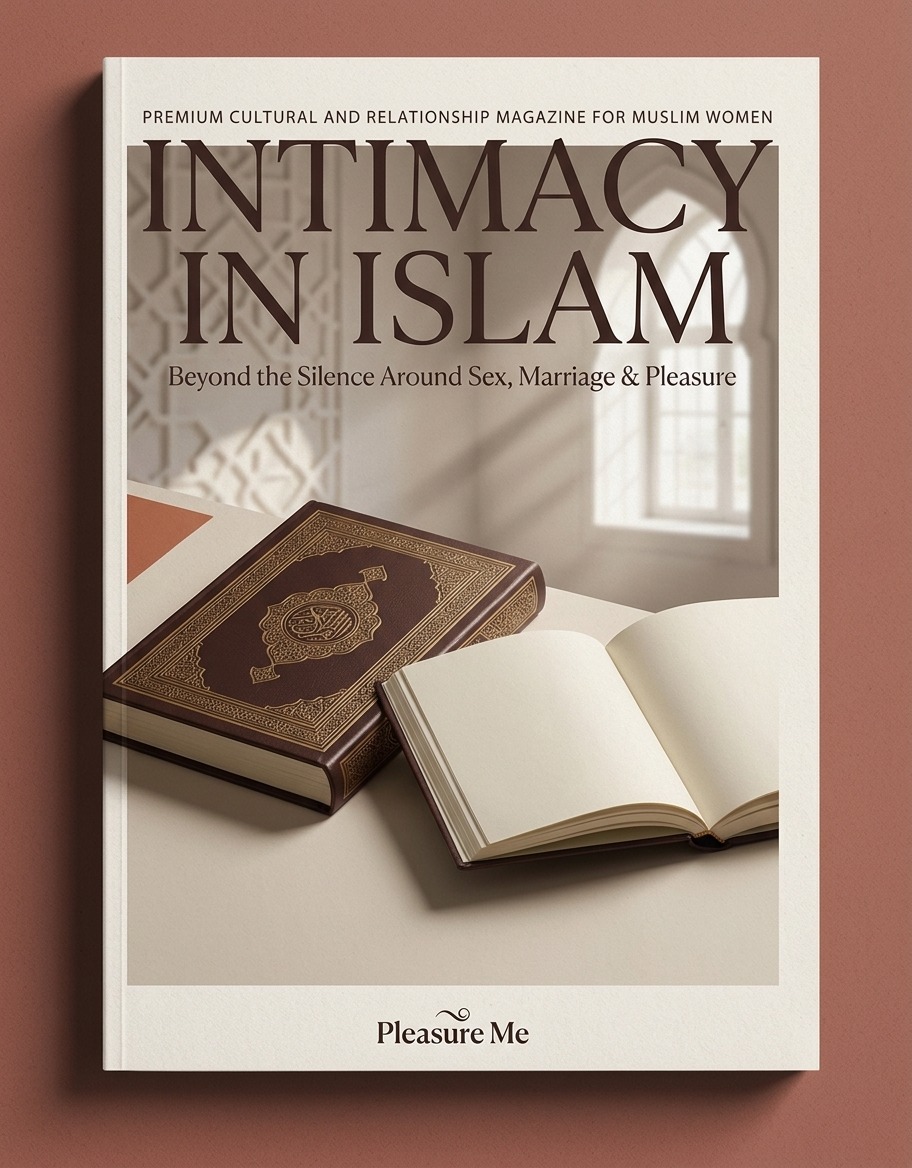
When people hear the words Islam and sexuality in the same conversation, the discussion can quickly become uncomfortable.
Some people assume Islam only speaks about what is forbidden.
Others assume that talking about sexual pleasure is inappropriate for Muslims altogether.
And some people have grown up with so much silence around intimacy that they enter marriage knowing very little about how Islamic teachings actually approach the subject.
But Islam's teachings on intimacy are more nuanced than simply saying "sex is allowed within marriage."
Islam addresses marriage, affection, desire, modesty, privacy, fidelity, mutual rights, family life and the responsibilities spouses have toward one another.
The challenge is that many Muslims learn about these subjects through a combination of religious teachings, family expectations, cultural traditions and personal experiences.
Those things aren't always the same.
So let's begin separating them.
Islam does not pretend that human desire doesn't exist
Sexual desire is part of being human.
Islam does not require people to pretend that attraction, desire, or physical intimacy don't exist.
Instead, Islamic teachings place sexuality within a moral and relational framework.
Marriage provides the context in which sexual intimacy is permitted, while broader Islamic teachings emphasize responsibility, modesty, fidelity and respect.
This distinction is important.
The existence of desire isn't necessarily the problem.
The question becomes how that desire is expressed and within what boundaries.
For Muslims, faith can therefore involve learning how to understand desire rather than simply being ashamed of having it.
Marriage is more than a permission slip for sex
Sometimes marriage is discussed as though its primary purpose is simply to make sexual intimacy permissible.
But the Qur'an presents marriage in much broader terms.
In Qur'an 30:21, spouses are described in connection with tranquility, affection, and mercy.
That paints a much bigger picture.
Marriage isn't simply about physical access to another person.
It's about companionship.
It's about emotional connection.
It's about building a life together.
It's about mercy.
It's about finding comfort and security with another person.
Sexual intimacy can be part of that relationship, but it exists within a much larger emotional and spiritual bond.
Affection matters
When people discuss Islamic marriage, they sometimes focus heavily on obligations while overlooking affection.
But love and tenderness have an important place in the Islamic tradition.
The Prophet Muhammad ﷺ is described in Islamic sources as showing affection and kindness toward his wives.
These examples challenge the idea that religious marriage must be emotionally distant or devoid of tenderness.
A marriage can have boundaries and still contain affection.
It can have modesty and still contain warmth.
It can be spiritually grounded and still acknowledge physical attraction.
These things don't have to contradict one another.
What about sexual pleasure within marriage?
This is one of the areas that often receives very little open discussion.
Yet classical Islamic scholarship did not simply ignore marital intimacy.
Islamic legal and ethical literature discusses matters related to sexual relations between spouses, including circumstances in which intimacy is permitted or restricted.
Different scholars and schools have differed on certain details, but the broader point remains:
Marital intimacy is not treated as a subject that doesn't exist.
It is discussed within a framework of lawful marriage, privacy, mutual responsibilities and religious boundaries.
That distinction is important for Muslims who may have been taught that simply asking questions about intimacy is itself shameful.
Learning about something responsibly isn't the same as acting irresponsibly.
The idea of mutuality deserves attention
One of the most important conversations we can have about intimacy in marriage is that marriage involves two people.
Two bodies.
Two emotional experiences.
Two sets of needs.
Two individuals.
That means intimacy shouldn't be understood solely through the desires of one spouse.
The Qur'an describes spouses as garments for one another in Qur'an 2:187 — a metaphor that has been understood in terms of closeness, protection, comfort, and intimacy.
That imagery is powerful.
A garment is close to you.
It provides covering.
It offers protection.
It is something associated with privacy.
The metaphor suggests a relationship characterized by closeness and mutual care rather than exploitation.
Consent and coercion need to be discussed carefully
Contemporary conversations often use the language of consent, while classical Islamic jurisprudence uses its own terminology and frameworks.
We should therefore be careful not to simply impose modern terminology onto historical texts without context.
At the same time, the broader ethical principles of Islam — such as kindness, mercy, avoidance of harm and good treatment of one's spouse — matter enormously when thinking about marital intimacy.
Marriage should never be used as an excuse for cruelty, humiliation, violence or abuse.
A person's marital status does not make harmful behavior acceptable.
This is an area where religious education and conversations about healthy relationships need to meet.
Modesty doesn't mean ignorance
This is perhaps one of the biggest misconceptions surrounding conversations about Islam and sexuality.
Some people believe that because Islam values modesty, Muslims shouldn't discuss sexual health, intimacy, desire or marital relationships.
But there is a difference between modesty and ignorance.
Modesty can influence how a subject is discussed.
It doesn't necessarily mean the subject cannot be discussed at all.
Muslims have historically asked scholars questions about marriage, menstruation, sexual relations, purification, pregnancy, and other intimate matters.
People needed answers.
And religious scholarship developed discussions around those questions.
There is therefore room for respectful, educational conversations about intimacy without turning the subject into something vulgar.
Culture can sometimes become confused with religion
This is where things become particularly complicated.
A Muslim may grow up hearing:
"Muslim women shouldn't talk about sex." "Good women don't express desire." "A wife should always be available." "Pleasure isn't something women should think about."
But an important question should follow:
Where exactly does this teaching come from?
Is it Qur'an?
Hadith?
A particular school of Islamic jurisprudence?
A scholar's interpretation?
Family tradition?
Local culture?
Or simply something someone was told growing up?
That doesn't mean the statement is automatically wrong because it is cultural.
But identifying the source allows people to distinguish religious guidance from social expectations.
Women and desire deserve a place in the conversation
Women are sometimes left out of religious conversations about sexual desire.
The discussion may focus heavily on men's desires while portraying women as passive participants.
But women experience attraction, desire, curiosity, emotional needs and physical pleasure too.
Islamic discussions of marriage have historically recognized that spouses have rights and responsibilities toward one another.
This matters because a healthy marriage cannot be built around pretending that one person's experience doesn't exist.
Women should be able to learn about their bodies.
They should be able to ask questions about marital intimacy.
They should be able to communicate discomfort.
They should be able to seek appropriate religious and health guidance.
And they should not automatically be made to feel sinful simply for having questions.
Religion and sexual education don't have to be enemies
A Muslim can want to understand intimacy while also wanting to remain faithful to Islamic principles.
Those two desires don't have to contradict each other.
In fact, education can help people make more informed decisions.
Understanding one's body can support better communication.
Understanding religious boundaries can help someone make choices consistent with their faith.
Understanding sexual health can help protect physical well-being.
Understanding emotional intimacy can help strengthen marriages.
The goal isn't to remove faith from the conversation.
It's to make the conversation more informed.
There are still boundaries
A conversation about Islamic intimacy should not become a suggestion that anything goes.
Islam has clear teachings concerning sexual relationships outside marriage, fidelity, modesty and other aspects of sexual ethics.
Those boundaries are part of the religious framework.
At the same time, acknowledging boundaries shouldn't require pretending that married couples don't have desires or that intimacy is something they should be embarrassed to discuss.
A mature conversation can hold both realities:
There are religious boundaries.
And there is also room for intimacy within those boundaries.
Questions are part of learning
Perhaps one of the most important things we can give people is permission to ask thoughtful questions.
What does Islam actually teach about marital intimacy?
What are the rights of husbands and wives?
How do different scholars interpret certain issues?
What is explicitly stated in the Qur'an?
What comes from hadith?
What is jurisprudence?
What is cultural?
These aren't questions that should automatically be shut down.
They deserve responsible answers.
And sometimes the answer isn't simply "yes" or "no."
Sometimes the honest answer is:
"Scholars differ."
That's okay too.
Religious literacy means learning to understand nuance.
Faith, intimacy and the modern Muslim
Muslims today are navigating conversations that previous generations didn't encounter in exactly the same way.
Social media exposes people to sexual content constantly.
Dating has changed.
Marriage expectations have changed.
People have access to information from around the world.
And conversations about women's pleasure, sexual health, consent, contraception, relationships and emotional intimacy are becoming more visible.
That creates challenges.
But it also creates an opportunity.
Instead of allowing social media or misinformation to become people's primary source of sexual education, there is room for thoughtful conversations that take both faith and well-being seriously.
Pleasure and spirituality don't have to be treated as opposites
For a married Muslim couple, physical intimacy can be part of their relationship while their faith continues to guide how they treat one another.
Love can be spiritual.
Companionship can be spiritual.
Kindness can be spiritual.
Marriage can be spiritual.
And within the boundaries established by their faith, intimacy can be part of married life rather than something that must always be surrounded by shame.
The goal isn't to turn religion into a permission slip for pleasure.
It is to understand the broader picture.
Faith can provide boundaries.
Marriage can provide commitment.
Communication can provide understanding.
And mutual respect can help create a healthy relationship.
A conversation worth continuing
This is only an introduction.
Islamic teachings around marriage and intimacy are extensive and there are important differences between schools of thought and scholarly interpretations.
In future conversations, we can explore specific topics more carefully rather than trying to answer everything in one article.
Because the goal isn't to tell Muslims what to believe.
The goal is to encourage people to learn, ask questions, seek qualified guidance and understand the difference between Islamic teachings and cultural expectations.
At Pleasure Me, we believe faith and intimacy can be discussed with respect.
Not through shame.
Not through sensationalism.
And not through assumptions.
But through education, context and honest conversation.
Because understanding your faith should never require you to stop asking questions.
Recommended for you
Shop all


Explore our collection for Intimacy
Shop the collection